Defamation / receivership / vehicles
Cars Sold by a Receiver: Buyer Beware
An attractive auction price does not tell a buyer how a car reached the sale yard. Behind one vehicle are a request made during wartime, a loan its owner says could not be located, disputed enforcement and service procedures, and harsh words recorded in and outside a hearing.
This article draws on bank records, enforcement documents, hearing records and judicial decisions. The vehicle owner's account and the transcript he submitted are identified as such. It does not find that anyone committed an offence or resolve the dispute over the amount owed. All quotations below are translated from Hebrew.
The buyer sees a car, but may not see its history
A vehicle offered for sale by a court-appointed receiver comes with an important legal consideration. Under section 34A of Israel's Sale Law, a sale by a court or enforcement office generally transfers ownership free of pledges, attachments and rights securing a monetary obligation. That protection does not, by itself, establish that every step preceding the sale was fair in its treatment of the people involved.
This is not the story of a buyer who has already purchased this car. It is a warning for a prospective buyer: before focusing on the price, ask whether the sale has been approved, who was appointed receiver, what has been disclosed about the vehicle and whether any application concerning the realization of the security remains pending. The Enforcement and Collection Authority describes a receiver as a lawyer appointed by a registrar's order and authorized to act in relation to an asset. The role operates under supervision.
October 2023: a wartime request and a bank record of delays
The vehicle owner says that the outbreak of the war damaged his business and that he asked Mizrahi Tefahot Bank to defer payments in light of the assistance framework announced by the Bank of Israel in October 2023. That framework offered deferrals and relief to eligible groups. The material reviewed does not establish that this particular loan met all the eligibility conditions. His account is that he requested the relief.
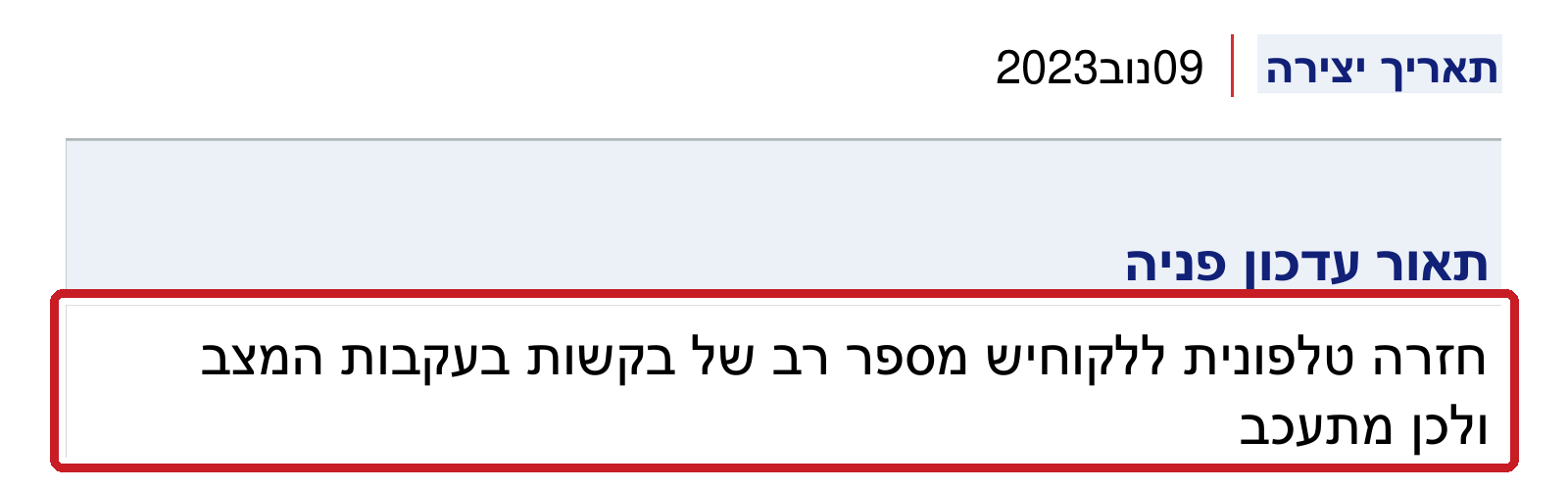
An internal record supplied by the bank in response to a request to inspect information adds an important piece of evidence. An entry dated 9 November 2023, following the words "Call back to the customer", states: "There are many requests because of the situation, so it is taking longer." Another entry at the same time says that further handling was required by the branch's designated contact. This is the bank's own record of workload and delay linked to the situation. The field provided does not expressly identify the request as concerning the vehicle loan.
Documents confirm that the vehicle owner was outside Israel during the relevant period. He says that, when trying to find out where the vehicle loan was being administered, he was told that no such loan appeared under his name in the bank's systems. The account of the October conversations is his own; the reviewed material did not include a recording or an explicit bank entry confirming their content.
Later enquiries are documented in writing. On 14 April 2024, he wrote to the leasing support service asking for "details about my vehicle, amounts owed and the outstanding loan balance." On 17 April, he told a company representative that payments had stopped being debited after the merger with Bank Igud, that he had been unable to establish where the loan had moved, and that he was abroad and wanted a settlement figure so he could sell the car. These documents show a written attempt to clarify and settle the account. They do not show that the loan was repaid.
From several thousand shekels in arrears to acceleration and receivership
A warning letter dated 28 February 2024 records arrears of NIS 5,349.59 as at 26 February, alongside a remaining future loan balance of about NIS 146,000. The smaller amount was the recorded arrears, not the entire outstanding loan. The loan was later accelerated and two enforcement routes were opened in connection with the same borrowing: realization of the vehicle pledge and enforcement of a promissory note. Their balances should not be added together as though they represented two separate loans.
The pledge enforcement file was opened in June 2024. The registrar's decision of 13 January 2026 states that attorney Victor Fisher was appointed receiver on 1 July 2024. Attorney Ofer Chen appears in some documents in the handling and service chain; those references do not establish that he was the appointed receiver instead of Victor Fisher. At the hearing on 13 January 2026, attorney Dotan Tzur appeared as counsel for the receiver and was recorded as being from Victor Fisher's law office.
The vehicle owner informed the office in May 2024 that he was abroad and supplied contact details. In December 2024, he again stated that he was outside Israel. Reports were nevertheless later submitted describing personal service on him in Israel. In the promissory-note proceedings, the enforcement registrar held on 21 October 2025 that the official travel record was inconsistent with the service reported for 22 December 2024. The service date was corrected, enforcement steps were cancelled and a second-stage attorney fee was cancelled. This was a decision in the promissory-note proceedings, not an automatic cancellation of the separate pledge enforcement proceedings.
The service date in the pledge proceedings was also ultimately corrected, to 2 December 2025. In the same decision, dated 13 January 2026, the vehicle owner's application to stay realization was refused and he was ordered to deliver the car. His application for leave to appeal was refused on 9 February 2026. Among other findings, the court said that the enforcement registrar was not the forum for a full monetary examination of the amount owed and criticized the owner's evasive answers about the vehicle's location.
On 31 May 2026, his objection to enforcement of the promissory note was also dismissed. The court noted that he did not deny receiving the loan and had not shown that it had been repaid. It said that, at most, the current balance might warrant examination, but no concrete calculations or evidence had been supplied to establish a sufficient defence. The observations concerning non-delivery refer to the circumstances examined in January and May; they do not describe the vehicle's present location.
These decisions form a substantive part of the story. The vehicle owner did not obtain an order stopping realization of the pledge, and the courts criticized his conduct. Those findings coexist with the bank's delay record, the written settlement enquiries, the corrections to service and the question of how the owner was addressed.
13 January 2026: what the hearing record says
At the hearing on the application to stay proceedings, attorney Dotan Tzur appeared for the receiver. The hearing record attributes the following words to him:
"A person who breaches an order to deliver a vehicle and does not deliver it is an offender who breaches a judicial order and commits an offence. […]
With all due respect to the old, respected and correct Hilulim precedent, when a person has operated an account for 20 years, he has a right to see how the final balance was reached. There is no connection between his having learned that dirty trick and our case.
He received a loan and admits it. The loan was paid through his bank account, and he knows how much was paid and exactly when. He can therefore check the current amount of the debt that the representative detailed here, here and now, all the more so because I am attaching a printout of the development of the debt. He says there are no details and no name; that is lies and falsehood. His entire affidavit about Igud Leasing and the claim that he received no breakdown are lies and falsehood. I do not need to give him any breakdown; he can calculate it with one click and see that I am right.
Apparently the car is not with him, or I do not know what, so he threatens me with a lawsuit. He admits NIS 140,000 in debt for the loan.
I ask, under the Contempt of Court Ordinance, after he refuses to deliver the car, say where it is or hand over the key, and after I have been looking for this car for more than two years because he knows exactly how to disconnect the Ituran and a number of other tricks he knows how to perform, that Your Honour exercise your authority to bring the car into my possession […]."
These are excerpts from submissions recorded from the receiver's counsel, not a finding by the registrar that every assertion in them was proved. Omissions are marked […], including a reference to the owner's former occupation removed to protect his privacy. The decision made that day did refuse a stay and require delivery of the vehicle, and the court that considered the subsequent application criticized the owner's answers.
Outside the hearing room: "liar, fraudster and criminal"
The vehicle owner submitted a transcript of a conversation he says was recorded immediately after the hearing. The original audio file was not included in the archive reviewed, and the documents reviewed contain no judicial finding that the transcript accurately reflects that recording. The passages below are therefore attributed to the transcript submitted by the vehicle owner.
According to that transcript, attorney Tzur said:
"One lie follows another. A liar, a fraudster and a criminal, that is what you are. All the way with you, all the way with you. […]"
When the owner asked, "Are you doing this to spite me?", the transcript records:
"A thief, a fraudster and a criminal. You should go to prison, thief and fraudster."
The transcript repeats the expressions "thief and fraudster" and "thief, fraudster and criminal" and also records:
"Do not speak to him; he will start telling things there, the scum of humanity."
"The scum of humanity. Laughing. You find it funny too. You find being a thief and a fraudster funny, right? Human scum. Disgusting... You find it funny. What a laugh, you stole a car, great, you hid the car."
According to the transcript, after someone present asked who was speaking, the conversation continued:
"A settlement... Have you ever seen a fraudster like this? He will never get a settlement. This fraudster will not get one... Thief and fraudster. This is a debt incurred through fraud. A swindler, a thief and a fraudster. A criminal. Laughing and laughing, that needs to be told too..."
"Human scum."
"Do not speak to me, scum."
"Thief, fraudster and criminal, so everyone knows."
The second page records:
"I do not want to be your friend. I will make sure you never get a settlement because you are a thief, a fraudster and a criminal. A debt incurred through fraud. That is what you did, and you will never get a settlement in your life, and everyone should know that this person is a thief, a fraudster and a criminal making a mockery of everyone. Stay away from me, scum. Stay away from me."
"I will go all the way with you. Until my last day, you will never get out of your debts in your life, scum. I will see to it. Me personally! Understood, scum?"
"Understood, scum, filth? Understood?"
"Filth and scum. Criminal and thief."
Assessing those words requires factual examination and the full context. This article does not determine who began the confrontation, what is audible in the original recording or whether a legal defence applies. The submitted transcript does, however, describe an exchange far removed from substantive legal argument.
Israeli law and the treatment of a vehicle owner
The opening of enforcement proceedings does not strip a person of dignity. Human dignity and property rights remain relevant, and civil proceedings are subject to fairness, good faith and the prohibition on abuse of process.
The professional ethics rules for lawyers require courteous treatment of the opposing party. They prohibit threats, while allowing a lawyer to explain lawful measures a client is entitled to take. They also require courtroom argument to respect the dignity of the opposing party and others connected with the proceedings. Whether a particular statement constitutes a disciplinary offence is for the competent bodies to determine.
Calling someone a "thief", "fraudster" or "criminal" within the hearing of others may fall within the definition of defamation under Israel's Prohibition of Defamation Law. The law also provides broad immunity for statements made by a party or counsel in the course of judicial proceedings. Statements recorded during the hearing therefore require a different analysis from words allegedly spoken in the corridor afterwards. Whether the latter also fall within that protection, whether publication occurred and whether other defences apply have not been resolved in the documents reviewed.
A receiver must realize an asset efficiently for the creditor while acting as a supervised office-holder, in good faith, reasonably and professionally. The power to seize and sell does not authorize humiliation. An alleged breach of an order is addressed through an application, evidence and a decision. Calling someone a criminal is not a substitute for an adjudication.
What the Torah says
The Torah recognizes repayment obligations and the creditor's right to recover what is owed. It also places limits on collection.
"You shall not act toward him as a creditor" appears in Exodus 22:24. Rashi explains this as a prohibition on pressing a person when it is known that they cannot pay. On taking a pledge, Deuteronomy 24:10-13 says: "You shall not enter his house to take his pledge. You shall stand outside." Even when a monetary right exists, the text sets a boundary around the other person's home and dignity.
"If your brother becomes poor... you shall support him... and he shall live with you" appears in Leviticus 25:35. Rabbinic teaching and Rashi emphasize helping before a person collapses completely. Bava Metzia 58b treats public humiliation as an especially grave injury. An obligation to repay does not cancel anyone's humanity.
These sources support moral scrutiny of the way a person is treated. They do not constitute a legal or halachic ruling on the taking of this vehicle. Questions of wrongful taking, the sale's validity and a buyer's responsibility require competent examination of the specific facts. This article makes no finding that the car was stolen or is wrongfully held property under Jewish law.
Buyer beware
The lesson is to examine the transaction and its documentation before buying a car from a receiver.
Ask to see the appointment order, approval of the sale, bidding conditions and disclosure of the vehicle's condition. Check for pending applications to stay or set aside the sale. Establish who holds the appointment and exactly what will be delivered. If a material unresolved dispute comes to your attention, ask for the relevant documents.
In this case, the owner received a loan, did not show that it had been repaid and failed in his applications to stop realization. Alongside those findings are a bank record of wartime workload and delay, written settlement enquiries, corrected service dates and a particularly harsh exchange attributed to the receiver's counsel after the hearing.
Those materials do not establish that the car is stolen or that buying it would carry a religious curse. They do support a more grounded moral question: a blessing in a transaction begins with confidence that power was exercised fairly, the vehicle owner was heard, the account was examined and nobody turned another person's distress into an opportunity for humiliation.
A car's ownership can be transferred. Its history may be harder to leave behind.