Legal proceedings / Bar Association / Second complaint
Second Bar Association Complaint Against Attorney Victor Fisher: The Car Sale
Second Ethics Complaint
On 26 October 2026 the counsel of the Israel Bar Association's Central District ethics committee wrote to the car owner: your complaint against attorney Victor Fisher has been received, its number is 665/2026, and it has been referred to the committee for examination. Two days later the car owner learned that his car had already been sold with the approval of the enforcement registrar, on a motion filed by attorney Fisher, the receiver and a partner at Chen Fisher Gabbay, on 21 October, the day the first complaint was filed. The motion was never served on him. It rested on two service confirmations by a process server whose two earlier services had been set aside by judicial decisions, on a claim that the redemption deadline had passed when, by the documents themselves, three days of seven had passed, and on another person's ID number next to the buyer's name. When this came to light, the attorney explained: "a clerical error by the handling clerk". The next day he wrote the same number again. A second complaint against attorney Victor Fisher is now being filed with the committee, with a request to join it to file 665/2026 and examine both complaints together.
In brief
- The first complaint (665/2026) was received by the ethics committee on 21.10.2026 and referred for examination; committee letter of 26.10.2026.
- The second complaint concerns the sale stage in the vehicle pledge file: the receiver's motion of 21.10.2026 and the decisions of 28.10, 29.10, 2.11 and 3.11.2026.
- Five heads: service confirmations, the redemption deadline, another person's ID number, the "verified" affidavit, and sale proceeds left in the receiver's hands.
- The car owner asks the committee not to wait for the enforcement file to close and not to shelve the complaint.
- These are one party's allegations. The committee has not ruled, and attorney Victor Fisher has not yet responded.
What the second complaint adds
The service confirmations. Two confirmations by the same process server were attached to the motion to approve the sale: a summons to the auction reportedly served on 4.10.2026 and signed by the car owner; and a redemption notice reportedly served on 18.10.2026, with three contradictory documents: "signed", "served", "refused to sign". The car owner declares that he never met the server and never signed. On 4.10.2026 at 11:35 the server phoned him, confirmed his address and said: "so I am sending the letter to this address". The call was recorded. A year earlier, Chen Fisher Gabbay itself had written of the same server: "it cannot be ruled out that he had someone else sign".
The redemption deadline. The motion of 21.10.2026 stated that "despite the passing of the deadline set in the notice" no objection had been received. The only deadline in the redemption notice is seven days from receipt, and according to the service confirmation the receiver himself attached, it was served on 18.10.2026. The registrar relied on the claim: "after the set redemption deadline had passed".
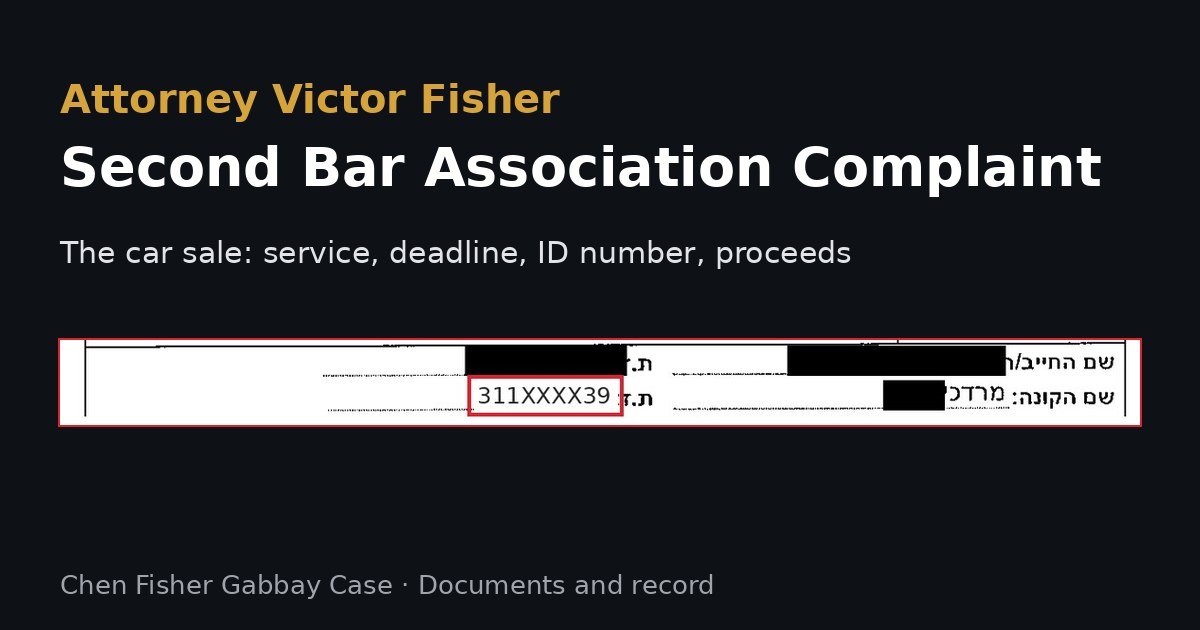
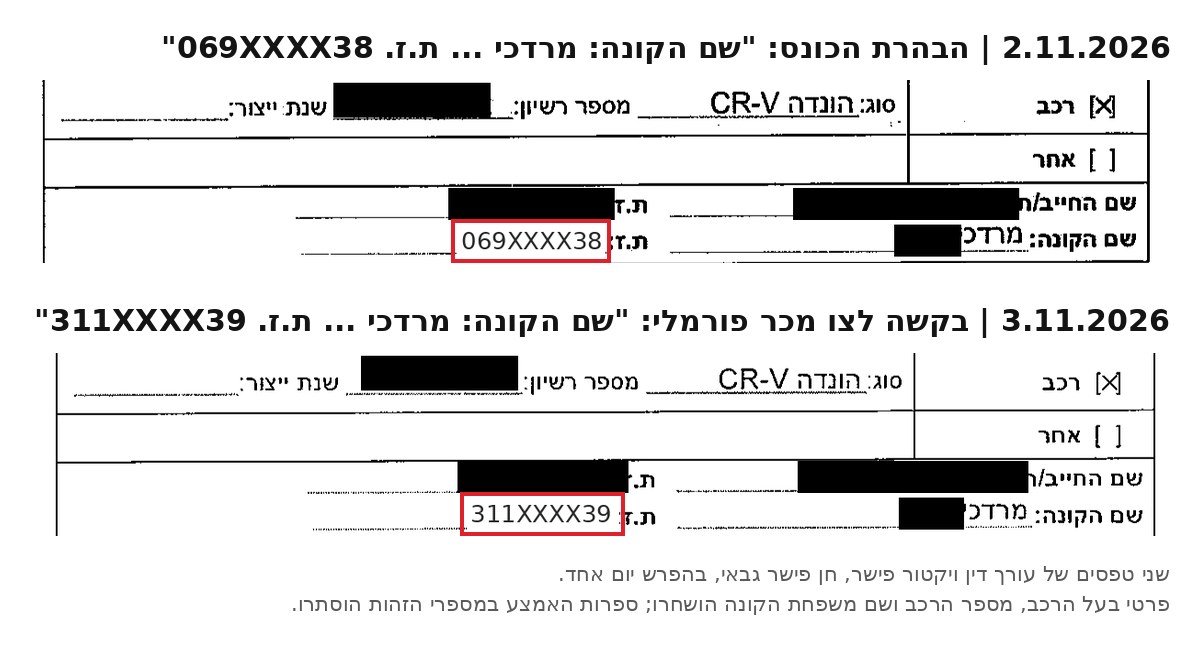
The ID number. The receiver asked to approve the sale to a buyer named Mordechai, and next to his name wrote, three times, an ID number that according to the Population Registry belongs to the buyer's daughter. The correct number appeared in the sale agreement the receiver himself signed and in the auction protocol he attached. The sale was approved that way on 28.10.2026. Only after the car owner filed an urgent motion and the registrar ordered a clarification did attorney Fisher write, on 2.11.2026, that this was "a clerical error by the handling clerk". On 3.11.2026, one day later, he filed a motion for a formal sale order, and in the field "buyer's name" wrote the daughter's ID number again.
The affidavit. The motion was supported by an affidavit of attorney Victor Fisher, attested by his partner, stating that "all the details set out in the attached report have been verified". The same wording had been used in the receiver's report of August 2026, which included a cancelled legal fee. The verified motion also states that the car was "seized", whereas the car owner delivered it himself on 6.9.2026.
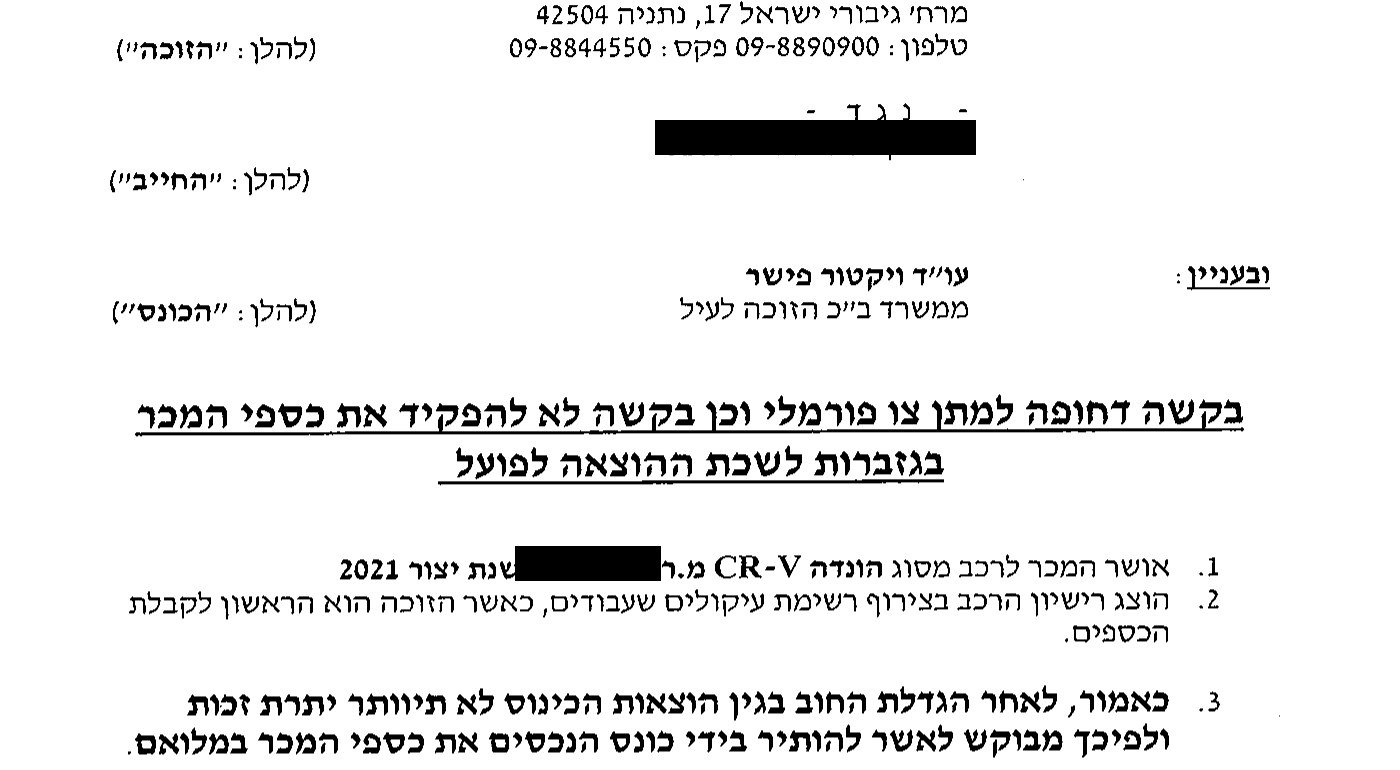
The sale proceeds. The sale agreement provides that the proceeds will be deposited "in the receiver's trust account". According to the record the receiver attached, NIS 66,150 were transferred from a third party's account to an account titled "current account" in his name. The decisions of 28.10 and 2.11.2026 ordered: "the full proceeds shall be deposited in the enforcement file". On 3.11.2026 the receiver asked "not to deposit the sale proceeds with the treasury" and to keep them, arguing that after the debt is increased by receivership costs, not yet requested, "no credit balance will remain". The registrar granted the request the same day.
Why not wait for the file to close
Ethics committees sometimes wait for a court proceeding in which the same facts are examined. The second complaint explains why that is not warranted here: the sale process is essentially over, with a formal order of 3.11.2026 and a debt reduction on 5.11.2026; the enforcement registrar ruled only on whether to set aside the approval of the sale, not on whether a lawyer may submit such documents to her backed by his affidavit; the core facts are not in dispute, since the receiver himself confirmed that the number is not the buyer's; and the first complaint is already under examination, so a joint review avoids duplication.
What the committee is asked to do
To join the complaint to file 665/2026, refer both to the attorney for his response, and file a disciplinary charge with the disciplinary tribunal under section 63 of the Bar Association Law. The committee is also asked to require attorney Victor Fisher to produce the original service confirmations, the work orders to the process server, the source of the ID number and the identity of the "handling clerk", an explanation for writing the number again on 3.11.2026, the details and classification of the account that received the proceeds, and an explanation for the request not to deposit the money with the treasury.
The decision that does not support the complaint
In her decision of 29.10.2026 the registrar held that the car owner's claims about the service confirmations "were not properly substantiated" and that "there is a presumption of service that has not been rebutted". The decision was given one day after the urgent motion was filed, before the car owner's affidavit had been attested. In the same decision the registrar ordered the receiver to clarify the ID number, and the clarification confirmed the car owner's claim.
What this article does not determine
This article describes what has been prepared for the committee and the documents in the enforcement file. Everything taken from the complaint is one party's allegation. Nothing here finds that attorney Victor Fisher or anyone at Chen Fisher Gabbay breached an ethical rule or a provision of law. The buyer and his daughter are not parties to the complaint and their details are not published. If attorney Victor Fisher provides a response, it will be published here.
Sources
- See also: Attorney Victor Fisher: the ethics complaint has been filed
- See also: Attorney Victor Fisher: two affidavits, two explanations
- See also: Attorney Victor Fisher
- Letter of the Central District ethics committee of 26.10.2026, ethics file 665/2026.
- Enforcement file 515509-06-24 (Haifa): receiver's motion to approve the sale of 21.10.2026, decisions of 28.10, 29.10, 2.11 and 3.11.2026, receiver's clarification of 2.11.2026, receiver's motion for a formal sale order of 3.11.2026.
- Bar Association Law, 5721-1961, sections 53, 54, 61 and 63; Bar Association Rules (Professional Ethics), 5746-1986, rules 2, 32(a) and 34(a).
Q&A: complaints about Chen Fisher Gabbay and the Israel Bar Association
Have complaints been filed with the Bar Association against attorney Victor Fisher?
Yes. On 21.10.2026 a complaint against attorney Victor Fisher of Chen Fisher Gabbay was filed with the Central District ethics committee. By letter of 26.10.2026 the committee confirmed receipt, assigned file number 665/2026 and stated that the complaint was referred for examination. A second complaint, concerning the car sale process, is being filed with a request to join it to the same file. The committee has ruled on neither.
Has a complaint been filed against attorney Ofer Chen?
No. This site documents no Bar Association complaint against attorney Ofer Chen. His name appears in the documents as the partner who attested attorney Victor Fisher's affidavit on 21.10.2026 and as the addressee of the process server's reports. The first complaint states expressly that it does not attribute to the respondent acts of other lawyers at the firm.
Which complaints about the Chen Fisher Gabbay firm are documented on this site?
Two complaints to the Bar Association ethics committee against attorney Victor Fisher (21.10.2026 and the second complaint described here), and two police complaints filed by the car owner (15.7.2026 and 29.10.2026) concerning service confirmations. Other articles on this site concern other lawyers at the firm but document no ethics complaints against them. All complaints are one party's allegations that have not been decided.
How do you file a complaint against a lawyer with the Israel Bar Association?
Fill in the ethics committee's complaint form for the district where the lawyer's office is located, attach an affidavit signed and attested by a lawyer and the supporting documents, and send by post in as many copies as there are respondents plus one for the committee. Material of up to 20 pages may also be emailed. Central District: 7 Tarmav St., Rishon LeZion, etika@merkazbar.org.il. Not using the form or omitting details may lead to the complaint being shelved.
What happens after a complaint is received by the ethics committee?
The committee examines the complaint and, if it sees fit, requests the lawyer's written response. It then decides whether to file a disciplinary charge with the disciplinary tribunal or to close the file. Committee deliberations are closed and the decision is sent to the parties. If a charge is filed, the tribunal hearing is generally public.