Legal proceedings / Professional ethics / Receivership
Attorney Anis Amira - Beware, Attorney
On 12 July 2026, Attorney Anis Amira of the Chen Fisher Gabbay law firm in Netanya wrote to a debtor in a vehicle pledge enforcement case, who is not represented by a lawyer, that in order to deposit the vehicle at a lot he would receive from her "forms for your signature". When he asked for the forms, on 6 September 2026, he received a letter of consent in which he waives service of a warning in the case, agrees in advance to an increase of the debt, and waives claims against the creditor and the receiver. In the correspondence presented to this article, Attorney Amira did not explain whether he was obliged to sign, what the basis for that would be, or how the letter fits with what was written to him earlier. The article examines the conduct in light of the article "Representing an Unrepresented Opposing Party - Attorney, Beware" by Dr. Limor Zer-Gutman.
Editors' note: The article is based on the email correspondence between the debtor and Attorney Amira (12.7.2026, 13.7.2026, 6.9.2026 and 8.9.2026), on a WhatsApp message of 6.9.2026, and on the letter of consent itself. What is presented as the debtor's understanding or actions is a party's claim, and this is stated explicitly. The content of the telephone conversation on the morning of 6.9.2026 was not recorded and is not addressed here. The article does not examine the Registrar's decisions concerning the deposit of the vehicle. It does not determine that the attorney or anyone involved violated any ethical rule or provision of law. Quotations from Hebrew documents are translated by the editors.
What was written to the debtor in July
On 12 July 2026, at 18:27, Attorney Anis Amira sent the debtor an email. After he had announced that he wished to deposit the vehicle, she wrote to him that he must come to the lot in Glilot, and ended as follows:
"Please update us on which day you wish to come so that we may send you forms for your signature accordingly and update the lot."
The message does not say which forms, under which provision they are required, or what they contain. According to the debtor's understanding, the deposit, which was intended to carry out a decision of Registrar Shirley Gideon, is conditional on filling in some forms. On 13 July he replied in writing that he rejects her letter and does not agree to a unilateral deposit.
6 September 2026: He asks for forms, receives a letter of waiver
At 7:40 the debtor wrote to Attorney Amira that he was on his way to the lot. According to him, the response filed in the case did not provide the details of the lot and did not attach "the forms required for handing over the vehicle", and therefore "I urgently need the required forms".
At 9:20 he received a WhatsApp message from an account under the name Victor Fisher. The message instructed him to deposit the vehicle at the parking lot in Glilot, and immediately afterward it said "a letter of consent is attached", with a PDF file named "Consent to the sale of a private vehicle". At 10:17 Attorney Amira wrote by email:
"Further to your conversation with us this morning and the sending of a consent form. Please update us after the vehicle is deposited that the deposit has been made."
The message does not state that a signature is required, and does not state that it is not required. According to the debtor, he did not sign the letter and deposited the vehicle, and on 8 September he sent Attorney Amira a confirmation of deposit and a notice that he had filed in the case.
What the letter says
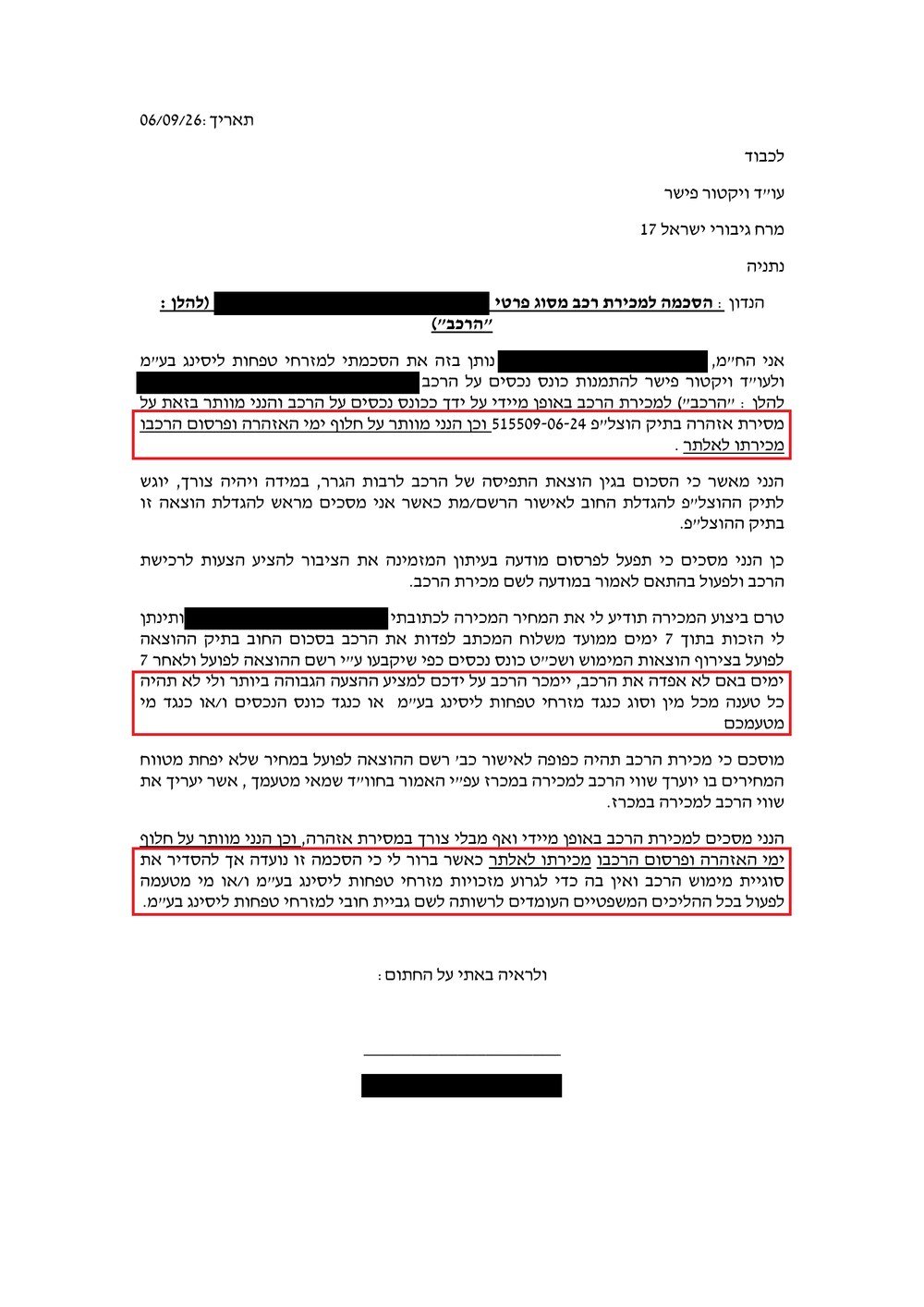
The letter is one page long, written in the first person in the name of the debtor and addressed to Attorney Victor Fisher. Its title, "Consent to the sale of a vehicle", concerns a sale. The deposit of the vehicle at the lot, for which the debtor asked for forms, is not mentioned in it. Among other things it provides:
- Consent that Mizrahi Tefahot Leasing Ltd. and Attorney Victor Fisher will be appointed receivers over the vehicle, and that the vehicle will be sold immediately.
- A waiver of service of a warning in enforcement case 515509-06-24, of the lapse of the warning period, and of publication of the vehicle.
- Advance consent that the costs of seizure, including towing, will be added to the debt in the case.
- If the debtor does not redeem the vehicle within 7 days, the vehicle will be sold to the highest bidder, and the debtor will have "no claim of any kind" against the creditor, the receiver or anyone on their behalf.
- A declaration that the consent does not detract from the creditor's rights to act in all legal proceedings to collect the debt.
The letter also contains protections. The sale is subject to the approval of the Execution Office Registrar and to a price not lower than the range of an appraiser's valuation, and the debtor is given a right to redeem the vehicle within 7 days of sending the notice of the price. However, according to its wording, it is the debtor who waives, and it is the creditor who reserves all of its rights. The letter also does not state that the debtor may consult a lawyer, and does not specify who drafted it.
What the article says about a lawyer facing an unrepresented party
Dr. Limor Zer-Gutman of the Faculty of Law at the University of Haifa describes in her article, published in the journal Din v'Dvarim (vol. 1, 5765), what may happen to a lawyer who represents a client against an unrepresented party. According to Israeli case law, the opposing party may be regarded as the lawyer's client even without explicit consent, or an enhanced duty of care may apply to the lawyer toward him. An example is the judgment in the Adv. Arad case, which the article discusses at length.
The article does not call for expanding the liability of lawyers. The author believes that the case law has expanded the duty of care excessively, and that this may deter people from retaining a lawyer and harm the lawyer-client relationship. For that very reason she recommends that every lawyer take two preventive steps: to make clear to the opposing party that the lawyer does not represent him, and to warn him explicitly, preferably in writing, that he cannot rely on the lawyer's acts or words and that he would do better to be represented.
The article also mentions the Supreme Court in the Sherman case, which held that where a lawyer represents one party in a legally complex transaction and the other party is unrepresented, the lawyer must clearly draw his attention to the fact that he would do better to be represented. As additional sources of duties toward the opposing party the article lists the ethics rules and the law of contracts. Rule 23 of the Israel Bar Association (Professional Ethics) Rules provides that a lawyer shall treat the opposing party with civility, and Rule 24 prohibits threats and permits a lawyer to specify the measures his client will take and to draw the opposing party's attention to the provisions of the law. The article notes that both rules deal mainly with style. From the law of contracts the article mentions the duty of good faith in negotiations, under section 12 of the Contracts (General Part) Law, 5733-1973.
What is missing from the correspondence
The article examines the conduct against the three questions raised by the article, according to the documents presented to it:
- Was it made clear to the debtor that Attorney Amira does not represent him? The correspondence contains no such statement.
- Was he warned that he cannot rely on her words and that he would do better to consult a lawyer? The correspondence contains no such warning, not in the July email, not in the email of 6 September and not in the letter itself.
- Was he told whether he is obliged to sign, and on what basis? No. In July he was told that "forms for your signature accordingly" would be sent to him. In September he received a letter of consent to a sale, which does not deal with the deposit, and which includes waivers that had not been mentioned before.
There is also a question of consistency. If signing was a condition of the deposit, why did the debtor deposit the vehicle without it, according to him, and why does the message of 10:17 ask only that he update after the deposit. And if it was not a condition, why was it written in July that forms for signature would be sent to him "accordingly". The attorney did not answer these questions in the correspondence presented.
Whether such conduct meets Rule 23 or other duties toward an opposing party is a question for the competent bodies, and the article does not decide it. What can be said on the basis of the documents is that the steps the article recommends, clarifying that she does not represent him and warning him to consult a lawyer, do not appear in the correspondence presented.
What is still unknown
- The content of the telephone conversation on the morning of 6.9.2026, to which the message of 10:17 refers.
- The wording of the Registrar's decisions concerning the deposit of the vehicle, and whether they require signing any document. They were not examined for the purposes of this article.
- Who drafted the letter of consent, and whether Attorney Amira drafted it or only referred to it.
For anyone who received a similar letter
Before signing a letter of consent or waiver that arrives from the opposing party, it is advisable to ask in writing whether the signature is required by law or by a decision, and which one. It is advisable to request the basis for this, to find out exactly what is being waived, and to consider consulting a lawyer. None of this is legal advice.
Response
A response received from Attorney Anis Amira, from the receiver Attorney Victor Fisher, or from the Chen Fisher Gabbay law firm will be published here.
Sources
- Emails from Attorney Anis Amira to the debtor of 12.7.2026 (18:27) and 6.9.2026 (10:17), and the debtor's replies of 13.7.2026, 6.9.2026 (7:40) and 8.9.2026. The emails are not linked because of identifying details
- WhatsApp message of 6.9.2026 (9:20) and the letter of consent, PDF with the debtor's details redacted
- Limor Zer-Gutman, "Representing an Unrepresented Opposing Party - Attorney, Beware", Din v'Dvarim 1 (5765)
- Israel Bar Association (Professional Ethics) Rules, 5746-1986, Rules 23 and 24
- Contracts (General Part) Law, 5733-1973, section 12
- CA 37/86 Levy v. Sherman, IsrSC 44(4) 446, and CA 6645/00 Adv. Arad v. Jacques Even, IsrSC 56(5) 365, as cited in the article