Privacy / receivership / vehicles
Victor Fisher, receiver in a vehicle pledge enforcement case, will not publish the debtor's personal information
A vehicle owner who deposited his car in a pledge enforcement case, in which the Chen Fisher Gabbay law office of Netanya represents the creditor, discovered that the receiver in the case, Victor Fisher, attorney, lists debtors' vehicles for sale on the Bidspirit online auction site. According to the request filed with Execution Registrar Shirley Gideon, the debtors' vehicle licences are published alongside the cars, and some of them show the owner's name, ID number and home address. The owner objected to the publication of his own licence before it went online, and the registrar ruled that the licence will be published without any detail identifying the debtor.
Editor's note: this article is based on the update notice and request filed by the debtor in file 515509-06-24 (request no. 14, 8 September 2026) and on the registrar's decision of 16 September 2026. Anything taken from the request is a party's claim and is presented as such. The registrar did not rule on the licences of other debtors or on whether the publication amounts to defamation. The article does not state that anyone committed an offence.
One car, and a list of thousands of licences
Execution file 515509-06-24 was opened at the Haifa office to enforce a pledge on a vehicle. The creditor is Mizrahi Tefahot Leasing Ltd., and Victor Fisher, attorney, of the Chen Fisher Gabbay law office, who represents the creditor in the same file, was appointed receiver over the vehicle.
On 6 September 2026 the owner deposited the car in accordance with the registrar's decisions, and the deposit confirmation was filed in the case. On the same day he wrote to the receiver's office with an explicit warning. According to the request he filed afterwards, he received no reply and the documents were not removed.
On 8 September the owner filed an update notice and request with the execution office. According to the request, the receiver publishes debtors' vehicle licences on an online sales portal operated by a third party. A check located and documented close to 4,000 vehicle registration documents, some of which still show the owner's name, ID number and address. Five such documents were attached as examples. The request also states that the documents are served to anyone, without registration, identification or verification, and remain accessible years after the sale ended. The portal on which the receiver's sales are listed is the Bidspirit auction site, as documented in an earlier investigation into vehicle licences published after receivership sales.
The owner's own licence had not yet been published, and the request was filed to prevent its publication in advance. In it he stated explicitly that he does not give, and never gave, consent to the publication of his vehicle licence, the licence plate number or any document bearing his identifying details. He argued that publication by a receiver is not a legal requirement: regulation 91 of the Execution Regulations, which governs sale by a receiver, contains no publication provision, and where the law does require publication, regulation 54(a) lists the details to be stated, and the only detail identifying the debtor on that list is his name. The request also referred to the position of the Privacy Protection Authority as published in its 2023 activity report.
What Registrar Shirley Gideon decided
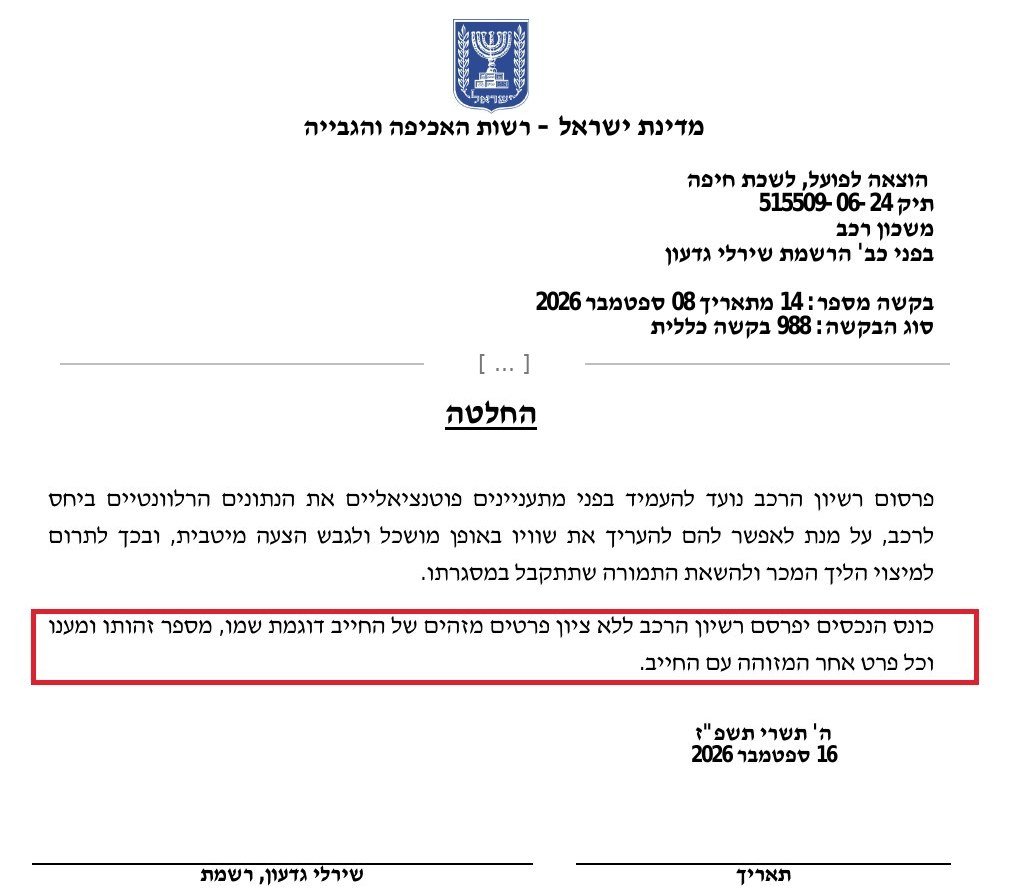
On 16 September 2026 the registrar issued her decision. She first defined the purpose of the publication: the vehicle licence is published to give interested buyers the data relevant to the vehicle, so they can assess its value and make the best offer, thereby helping to complete the sale and maximise the proceeds. From this followed one operative instruction:
"The receiver will publish the vehicle licence without stating details identifying the debtor, such as his name, ID number and address, or any other detail identified with the debtor." (translated from Hebrew)
The decision does not prohibit publishing the vehicle licence for the sale. It separates the car from its owner: the buyer needs to know what he is buying, not from whom it was taken. The decision was given in one file and concerns one debtor, and it does not address the thousands of other documents mentioned in the request.
What a vehicle licence says when it is published with the owner's name
A vehicle licence shown on a receiver's sale page, next to a name, ID number and address, is not technical data. The context tells the whole story: a person whose car is sold in receivership bought it with financing, pledged it to secure the loan, and the creditor opened proceedings to enforce the pledge. Anyone searching for receiver car sales receives that information about a specific person, by name and address.
Section 1 of Israel's Prohibition of Defamation Law defines defamation as anything whose publication may, among other things, humiliate a person in the eyes of others or harm him in his position, business, occupation or profession. Whether such a publication meets that definition, and which defences are available to the publisher, is a legal question that was not put to the registrar and was not decided. The registrar answered a more practical question: what the buyer needs. Her answer was the vehicle's data, not the debtor's identity.
Publishing on the internet: an audience without limits, a time without end
In his book on Israeli defamation law, Uri Shenhar devotes a full chapter to the special problems of publication in the media and on the internet. According to the analysis there, the network allowed any person to reach a vast audience without the resources of a media outlet, and Justice Rivlin described it in LCA 4447/07 Mor v. Barak ITC as the new "town square". But the same square works in the opposite direction too: harm published there may reach a wide audience and last, in the book's words, "forever", for as long as the publication stays online.
Shenhar further explains that a printed newspaper's archive takes effort to reach, while an online publication is retrieved again every time someone types a person's name into a search engine. Connections on social networks carry the harm into the victim's family, social and professional circles, where it hurts more. In LCA 1239/19 Shaul v. Nidaily Communications the Supreme Court held that sharing a post on a social network creates a kind of copy displayed to the sharer's friends, and is therefore a publication in its own right.
On the other hand, Shenhar notes that online it is relatively easy to remove or correct a publication, and that timely removal prevents the harm from accumulating. That is exactly what the vehicle owner asked for: not to correct after the fact, but to prevent in advance his licence, with his details, from being posted on a sales site and remaining there for years after the car is sold.
A private person, not a public figure
The legal debate about reduced protection of a person's good name concerns public figures: people who chose public life and who have access to the media to answer criticism. Shenhar describes the debate in case law and literature around this question. A debtor in an execution file is not a public figure. He has no platform from which to answer a sale page viewed by thousands, and there is no public interest in his name or address. The legitimate public interest is in the car offered for sale.
The balance between freedom of expression and the right to a good name was discussed at length by the Supreme Court in the further hearing in FH 2121/12 Anonymous v. Dayan-Orbach, which concerned a journalistic publication on a matter of public interest. The registrar's decision does not even require such a balance: there is no public interest in the debtor's identity, and there is one defined purpose, selling the car, which does not require his details.
For anyone looking at cars sold by a receiver
A buyer considering a car sold by a receiver needs the vehicle's data: model, year, condition, the vehicle's own registration documents and the approval of the sale in the file. The debtor's name, ID number and address are not needed to assess its value, and that is exactly the distinction that follows from the reasoning of the decision. Other debtors whose cars are sold by a receiver, and whose documents are published with identifying details, can refer to this decision and ask for similar relief in their own file.
Response
According to the request, the owner's letter of 6 September 2026 to the receiver's office went unanswered. Any response received from the Chen Fisher Gabbay law office or from Victor Fisher, attorney, will be published here.
Sources
- Decision of Registrar Shirley Gideon, Haifa Execution Office, request no. 14 in file 515509-06-24, 16 September 2026 (PDF in Hebrew, debtor's details redacted)
- Debtor's update notice and request, request no. 14 in file 515509-06-24, 8 September 2026, and the debtor's letter to the Chen Fisher Gabbay law office, 6 September 2026. Not linked because they contain identifying details
- Execution Regulations, 5740-1979, regulations 54(a) and 91
- Prohibition of Defamation Law, 5725-1965, section 1 (Hebrew)
- Uri Shenhar, Dinei Lashon HaRa (Defamation Law), 2nd edition (2024), chapter 5: media, internet and public figures, pp. 105-128 (book details)
- LCA 4447/07 Rami Mor v. Barak ITC (1995) International Telecommunications Services Ltd (25 March 2010, Hebrew)
- LCA 1239/19 Shaul v. Nidaily Communications Ltd (8 January 2020, Hebrew)
- FH 2121/12 Anonymous v. Dayan-Orbach (18 September 2014, Hebrew)
- Earlier investigation: vehicle licences published after receivership sales